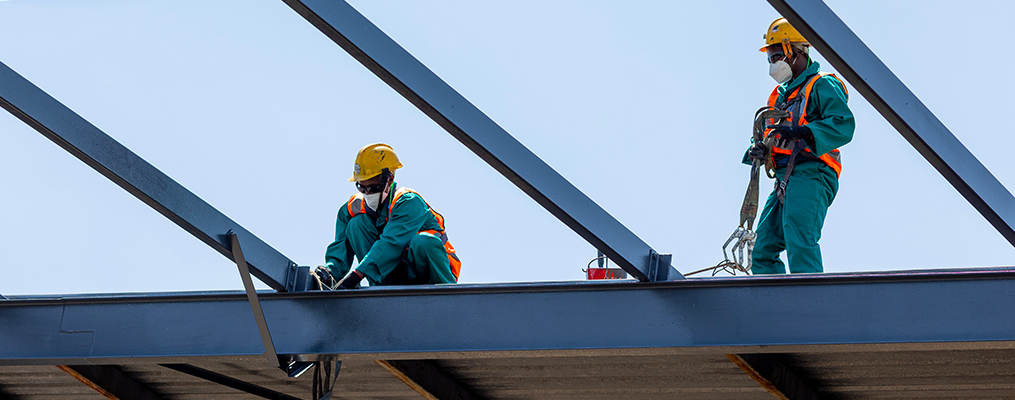
 by Ethan Mungate
Choosing the Right Rope Access Company for Maintenance
Key Point Summary
- Certification is the baseline, not the goal. IRATA credentials matter, but the best rope access companies back them up with active on-site supervision, detailed risk assessments and tested rescue plans.
- Access and execution must go together. A contractor who can reach the problem but cannot fix it creates fragmented accountability. Look for industrial rope access specialists who self-perform the maintenance work.
- Real industrial experience changes outcomes. Working in a live facility is different from working on a blank canvas. Top rope access contractors anticipate operational constraints before they become problems.
- Disruption is a hidden cost. Poor planning — not the work itself — causes the most downtime. The right rope access firm plans around your operations, not the other way around.
- A single, integrated partner reduces risk. One team, one scope, one standard of accountability. That is what separates the best rope access companies from those who simply get technicians onto ropes.
Introduction
Not all work at height requires scaffolding — and not all rope access companies deliver the same level of safety and expertise. For facility managers, choosing the right partner can mean the difference between efficient maintenance and unnecessary risk. From IRATA certification to technical capability, this guide breaks down exactly what to look for when selecting a rope access company in South Africa.
Why Choosing the Right Rope Access Company Matters
Working at height has always carried a certain tension. It’s not just about getting the job done — it’s about how it’s done, who’s doing it and what’s at stake if something goes wrong.
Across South Africa’s industrial and commercial sectors, industrial rope access has become a preferred method for facility maintenance because it offers speed, flexibility and minimal disruption. But that efficiency can be misleading. The method is only as reliable as the people behind the ropes.
Selecting a rope access company is not a procurement exercise you rush through. It’s a decision that directly affects safety, downtime and the quality of work delivered on your facility — especially when that facility is a live industrial environment.
The Promise of Industrial Rope Access — and the Reality
On paper, industrial rope access solves a lot of problems. No scaffolding. No heavy machinery. Faster turnaround. Lower costs. These are real advantages — but only when the right contractor is involved.
In practice, those benefits only materialise when the contractor understands both access and the work itself. Too often, rope access companies position themselves as access specialists but rely on subcontractors to carry out the actual maintenance. That’s where things start to fragment.
You end up with multiple teams, blurred accountability and a higher risk of something slipping through the cracks. When you’re dealing with roofing, protective coatings or structural elements, “almost right” is not good enough.
Safety Is Not a Selling Point — It’s the Baseline for Any Reputable Rope Access Firm
Every rope access company will tell you they prioritise safety. The real question is whether their processes back that up.
IRATA certification is a strong starting point for evaluating rope access companies in South Africa, but it is not the complete picture. What matters is how those standards are applied on-site. Are risk assessments site-specific or generic? Is supervision active or reactive? Is there a documented rescue plan that gets rehearsed, not just filed?
In high-risk industrial environments, safety is not something you verify once and move on. It needs to be visible in every decision, every rigging setup and every movement on the ropes. When assessing the best rope access firms, this operational discipline is what separates serious contractors from those who are simply certified on paper.
Why Experience Sets Industrial Rope Access Specialists Apart
There’s a quiet but important difference between a team that knows rope access and a team that understands your environment.
An industrial facility is not a blank canvas. It’s a live, complex system with production schedules, safety protocols and operational pressures. Maintenance work must fit into that rhythm without disrupting it — and that requires contractors who have genuinely been there before.
Industrial rope access specialists with real facility experience will anticipate challenges before they become delays. They’ll know how to work around active operations, how to navigate confined or hazardous spaces, and how to deliver results without slowing everything down.
That kind of experience doesn’t show up in a brochure. It shows up in how smoothly the job runs and how rarely things need to be revisited.
Access Is Only Half the Job — What Top Rope Access Contractors Do Differently
Reaching the problem is one thing. Fixing it properly is another.
This is where many rope access contractors fall short. They get technicians to the point of access, but the actual maintenance — whether it’s corrosion protection, roof repair or fireproofing — is either outsourced or treated as secondary to the access work.
The top rope access contractors take an integrated approach. When the same team can inspect, assess and resolve issues in a single process, you eliminate delays, miscommunication and rework. It’s cleaner, faster and far more accountable.
For facility managers evaluating rope access companies in South Africa, asking a simple question cuts through the noise: does your team carry out the maintenance work itself, or does someone else do it? The answer tells you a great deal about the level of accountability you’ll actually receive.
The Hidden Cost of Disruption When Working at Height
One of the biggest advantages of industrial rope access is minimal operational disruption. But that advantage disappears quickly when the work is poorly planned.
Downtime doesn’t always come from the work itself. It comes from inefficiencies, delays in mobilisation, unclear scopes, or teams that need constant client-side oversight just to stay on track.
The right rope access company understands that your facility doesn’t stop because maintenance is happening. They plan around your operations, not the other way around. This is particularly important for rope access in Johannesburg and other major industrial hubs, where facilities operate under tight production windows and any extended downtime has measurable financial consequences.
What the Best Rope Access Companies in South Africa Actually Look Like
When you step back, the pattern becomes clear. The best rope access companies are not just technically capable — they’re operationally aware. They understand safety standards, but they also understand pressure. They know the certifications, but they also know the reality of a working industrial facility.
This is where DRAM stands apart from other rope access contractors. By combining IRATA-certified rope access with in-house expertise in coatings, roofing and fireproofing, DRAM offers more than access — it offers resolution.
Instead of multiple contractors and fragmented responsibility, you get a single partner who can access, assess and complete the work to a consistent standard. For facilities across Gauteng, rope access in Johannesburg and nationally throughout South Africa, that integrated capability makes a measurable difference to safety, cost and turnaround time.
Conclusion
Choosing a rope access company is not about who can get to the highest point. It’s about who you trust once they’re there — and what they’re capable of doing once they arrive.
In industrial environments where safety, time and quality are under constant pressure, that choice carries weight. The right contractor won’t just complete the task. They’ll make the entire process smoother, safer and more efficient from mobilisation through to sign-off.
If you’re looking for industrial rope access specialists who understand both access and execution, speak to DRAM about a tailored solution for your facility.
Frequently Asked Questions
What is industrial rope access?
Industrial rope access is a method of reaching elevated or difficult-to-access areas using specialised ropes, harnesses and safety systems. It is commonly used for inspection, maintenance, repairs and protective coating work where scaffolding or heavy access equipment may be impractical.
What should I look for when choosing a rope access company?
Look for recognised safety certification, experienced technicians, detailed risk assessments, active supervision and a site-specific rescue plan. The contractor should also have the technical expertise required to complete the maintenance work, rather than only providing access.
Is rope access safer than scaffolding?
Both methods can be safe when properly planned and managed. Rope access can reduce certain risks by limiting the amount of equipment installed on site, but its safety depends on trained personnel, compliant equipment, proper supervision and a suitable rescue procedure.
What work can rope access contractors perform?
Rope access contractors can perform inspections, roof repairs, waterproofing, corrosion treatment, industrial coating application, fireproofing work, cleaning and other maintenance tasks on difficult-to-reach areas.
How does rope access reduce operational disruption?
Rope access usually requires less equipment, setup time and ground-level space than scaffolding. This allows maintenance teams to work around active operations while reducing access restrictions and disruption to employees, production and logistics.
Why choose a contractor that combines rope access with maintenance expertise?
A contractor that provides both access and technical execution can inspect, assess and complete the work through one coordinated process. This reduces handovers, delays, miscommunication and fragmented accountability between multiple service providers.